

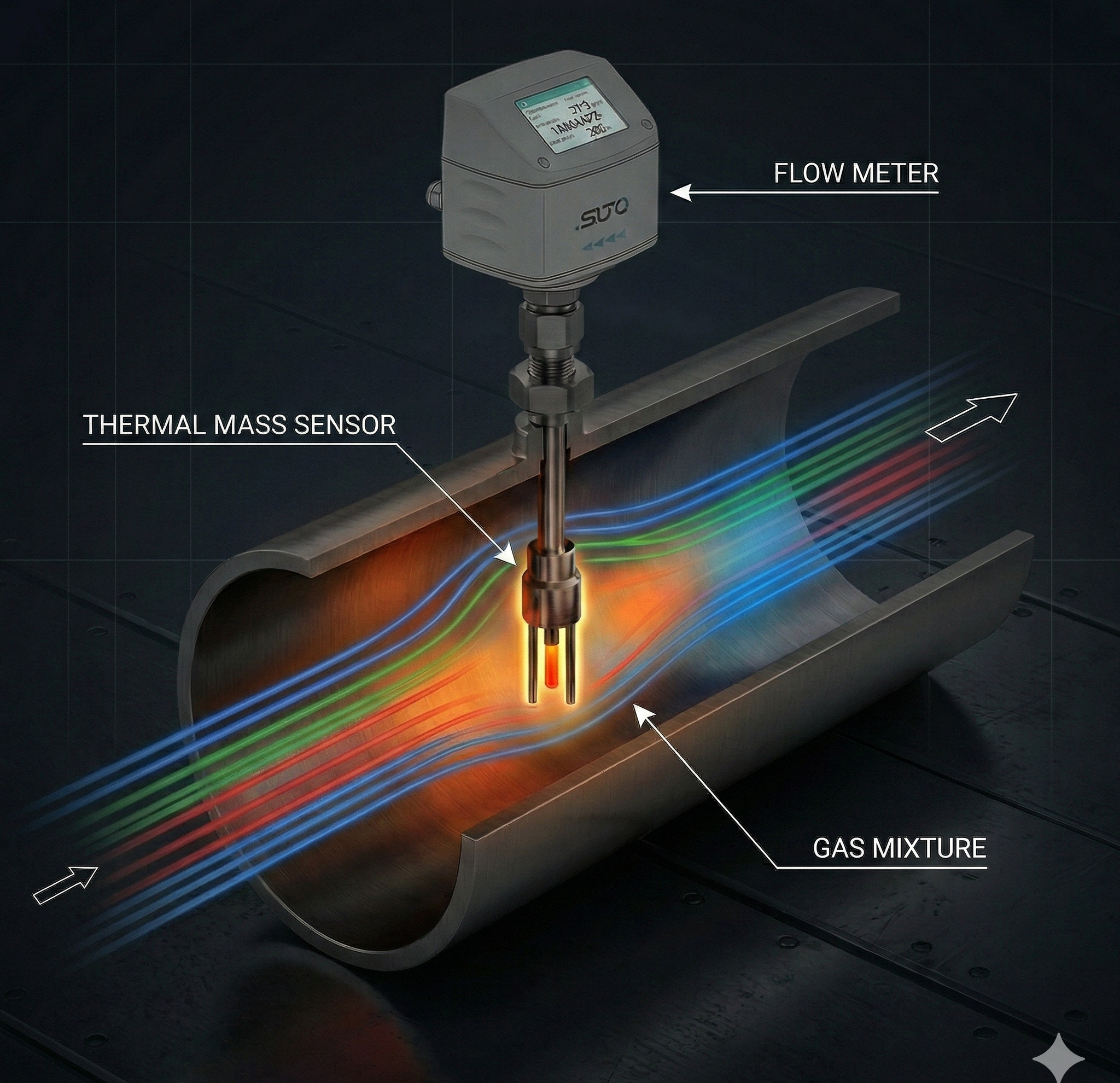
If you work in manufacturing, you're using industrial gases whether you realize it or not. Some plants track every kilowatt of electricity but have no idea how much gas flows through their lines each month.
Here are the three gas mixes I see most often in the field—and why measuring them matters.
1. Compressed Air
Not a "mix" technically, but it's the most used industrial gas by volume. Every plant has it. Pneumatic tools, actuators, blow-off stations, packaging lines—compressed air runs everything.
The problem: Leaks eat 20-30% of your output. I've seen plants running an extra compressor just to compensate for leaks nobody bothered to fix.
What to measure: Total system flow at the compressor discharge, then sub-meter high-consumption areas. The SUTO S401 handles main lines up to 12" and installs under pressure—no shutdown required.
If you suspect you have a leak problem, a professional leak detection audit can identify and quantify exactly where you're losing air—and money.
Related: Solar Panels vs. Air Leaks — why fixing leaks often beats installing solar panels for ROI.
2. Argon + CO₂ (Welding Shielding Gas)
If you have welding stations, you're running argon mixes. The most common:
- 75% Argon / 25% CO₂ — Standard for MIG welding carbon steel. Good penetration, minimal spatter.
- 90% Argon / 10% CO₂ — Cleaner welds, less spatter, used for thinner materials or when appearance matters.
- 98% Argon / 2% CO₂ — For spray transfer on thicker steel.
- Pure Argon — TIG welding aluminum and stainless steel.
The problem: Welding stations waste gas constantly. Pre-flow too high, post-flow running forever, regulators left open during lunch. One station can blow through hundreds of cubic feet per week doing nothing productive.
What to measure: Flow at each welding bay. Compare consumption between shifts and operators. You'll find your gas hogs fast. The SUTO S421 inline meter fits branch lines down to 1/2" with multiple gas calibrations—same unit works for argon, CO₂, or mixed gases.
3. Nitrogen + CO₂ (Food Packaging MAP)
Modified Atmosphere Packaging (MAP) replaces the air inside food packages with a controlled gas mix to extend shelf life. Different products need different mixes:
- 100% Nitrogen — Chips, nuts, coffee. Displaces oxygen to prevent oxidation and rancidity.
- 70% N₂ / 30% CO₂ — Fresh pasta, baked goods. CO₂ inhibits mold and bacteria.
- 20% CO₂ / 80% N₂ — Red meat. Balances color preservation with microbial control.
- 30% CO₂ / 70% N₂ — Poultry and fish. Higher CO₂ for shorter shelf-life products.
The problem: MAP packaging lines run fast and use gas continuously. Small inefficiencies multiply quickly. A 5% over-consumption on a line running three shifts adds up to serious money by month's end.
What to measure: Gas flow per packaging cycle or per unit produced. Establish a baseline, then flag deviations. Worn seals, incorrect settings, and equipment drift show up immediately in the flow data.
The Common Thread: You Can't Fix What You Don't Measure
Whether it's compressed air, welding gas, or food-grade nitrogen, the pattern is the same:
- Install flow meters at strategic points
- Establish baseline consumption
- Identify waste and anomalies
- Fix issues and track improvements
SUTO thermal mass flow meters handle multiple gas types with ±1.5% accuracy and a 200:1 turndown ratio. One platform covers compressed air, nitrogen, argon, CO₂, and mixed gases.
If you're managing gas consumption by "we order more when we run low," you're leaving money on the floor. A supply-side analysis can help you understand exactly where your gas is going and where to focus optimization efforts.
You might also like:
- Why a Master Controller Can Save 30% — optimizing multi-compressor systems
- Solar Panels vs. Air Leaks — the ROI comparison that surprises everyone
— Brisa